 English
 Deutsch
 Français
 Dansk
 Nederlands
 Italiano
 Español
 Português

Clematis 'Bells of Emei Shan'

Clematis 'Bells of Emei Shan'
Growth height 150 cm
Fragrant Bells from China
- – Yellow, fragrant bell-shaped flowers from June to September
- – Trailing habit – perfect for hanging baskets and covering banks
- – Rare wild form from Mount Emei with ornamental seed heads
Unfortunately not available at the moment.
Similar varieties you can order now

Fertiliser included – free shipping within Germany
Add a promotional item – we deliver the entire order with free shipping.
The discount applies per item: every promotional item in the basket reduces the shipping costs by the amount of one parcel.
Handy extras
Fertiliser included – free shipping within Germany
Select size – we deliver the entire order with free shipping. Everything ships together.
Goes well with

- Colour
- yellow
- Height
- 150 cm
- Flower size
- 3 cm
- Flowering period
- June to September
- Pruning / care
- cut back to 100 cm in June
- Pruning group
- 1
- Hardiness
- Zone 9 -6.6 to -1.2 °C
- Supplied as
- 2 l pot, with sturdy shoots
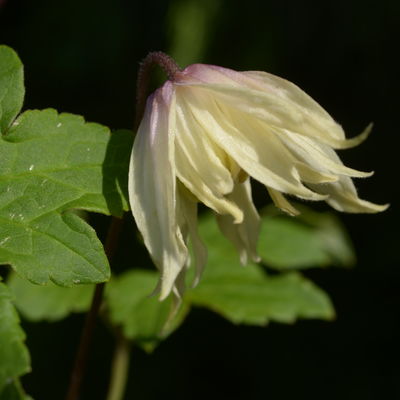
The clematis 'Bells of Emei Shan' originates from a wild collection made by the American plant hunter Dan Hinkley, who found seed from a single plant in 1996 in the Emei Shan region of Sichuan, China; the variety was named in 2006. Its nodding, bell-shaped flowers appear in bright yellow, reach about 3 cm, are pleasantly fragrant, and their leathery tepal tips curl outward with age.
'Bells of Emei Shan' flowers from June to September and stays fairly compact at around 150 cm. Unlike many clematis, it grows in a trailing rather than climbing habit – the stems barely reach upward and instead spread flat. This makes the variety ideal for hanging baskets, window boxes or trailing over low walls and banks; it also finds support along open woodland edges and among larger shrubs. It thrives in sun to part shade, with the root area kept cool and shaded.
With zone 9 (-6.6 to -1.2 °C), 'Bells of Emei Shan' is one of the less frost-hardy clematis varieties and needs winter protection in colder areas. In mild regions it remains semi-evergreen. For vigorous new growth and abundant flowering, cut the plant back to about 50 cm in March.
Experiences and pictures from our visitors (0)
✓ this is about the plant, not the parcel service ✓ many years of experience and pictures from many regions ✓ more than 1,000 posts since 2002


Read here what you should bear in mind when planting and how to prepare the planting site.
Everything about pruning groups and how to interpret them for the right pruning.


